Showing posts with label Bitcoin Magazine. Show all posts

Saturday, March 8, 2025

White House Draws Line Between Bitcoin And Digital Assets At Its First Crypto Summit, In EO

March 08, 2025 0

Bitcoin Magazine

White House Draws Line Between Bitcoin And Digital Assets At Its First Crypto Summit, In EO

“From this day on, America will follow the rule that everyone in Bitcoin knows very well — never sell your Bitcoin.” -President Donald Trump, 3/7/25 at inaugural White House Crypto Summit

The President of the United States is now reciting popular Bitcoin maxims as they pertain to America’s bitcoin stack.

Wild.

It’s clear that he’s gotten the message that bitcoin is something altogether different than all other digital assets.

He’s proven this not only by what he said at today’s Crypto Summit, but also by signing an executive order (EO) last night that established a Strategic Bitcoin Reserve (SBR) independently of a Digital Asset stockpile.

The Strategic Bitcoin Reserve

Regarding the SBR, the President said today that the U.S. plans to hold onto the bitcoin it has in its possession, unlike previous administrations who have sold massive sums of it. 

“Unfortunately, in recent years, the U.S. government has foolishly sold tens of thousands of bitcoin (200,000, by some estimates) that were worth billions and billions of dollars had they not sold them,” said President Trump.

That said, the President also shared that members of his administration will pursue avenues to accumulate bitcoin — at no expense to the American public.

“The Treasury and Commerce departments will explore new pathways to accumulate additional bitcoin holdings for the reserve, provided it’s done at no cost to the taxpayers,” he said.

“We don’t want any cost to the taxpayers,” he reiterated, highlighting the notion that the U.S. government plans to amass bitcoin in a “budget-neutral” (to borrow language from last night’s EO) manner.

Attendees

Treasury Secretary Scott Bessent and Commerce Secretary Howard Lutnick were present at the summit alongside approximately 30 prominent members of the Bitcoin and crypto industry, including Strategy Executive Chairman Michael Saylor, Coinbase CEO Brian Armstrong, Gemini co-founders Cameron and Tyler Winklevoss, and BTC Inc. CEO David Bailey.
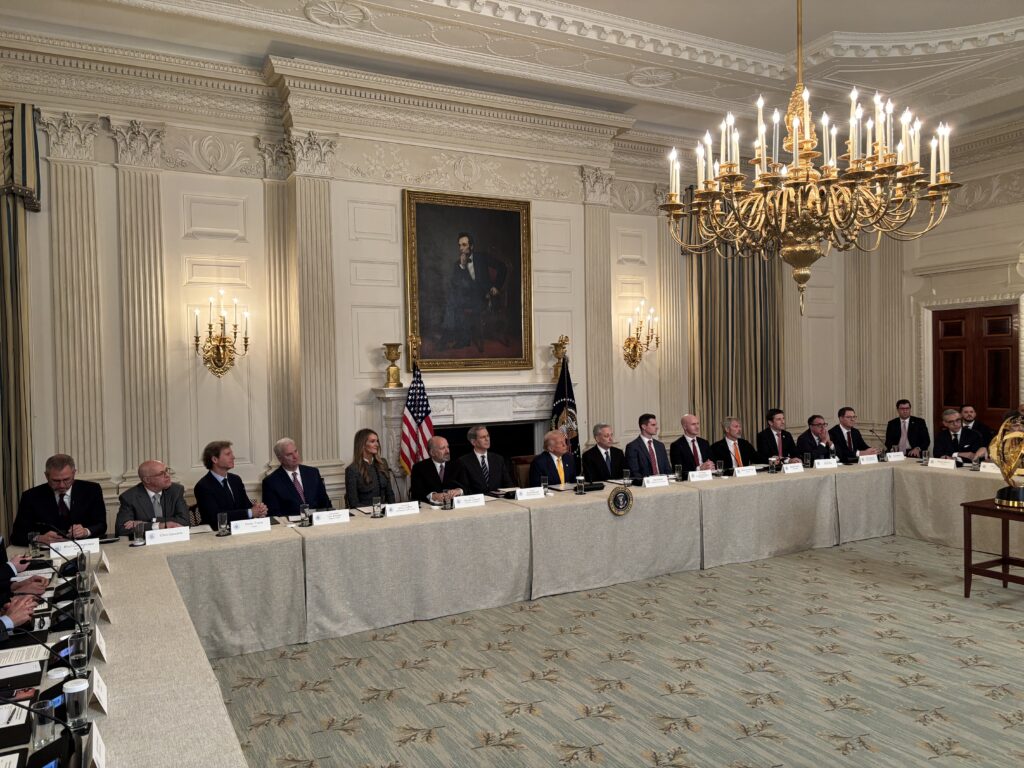
President Trump with nearly three dozen notable members of the Bitcoin and crypto industry. Photo credit: Frank Corva

Other members of the Trump administration, including head of Small Business Administration Kelly Loeffler and White House Crypto Czar David Sacks, were also in attendance.

Both Sacks and Loeffler praised the pace at which Trump is making progress with Bitcoin and crypto executive orders and legislation.

“Your administration is moving at tech [startup] speed,” said Sacks.

“It’s actually faster than any startup that I’ve been part of,” added the venture capitalist, well-known for investing in many tech startups over the course of his career.

Secretary Lutnick vouched for President Trump’s newfound Bitcoin and crypto knowledge, adding that the President has truly come to embrace the technology.

“Blockchain and Bitcoin technology are a key part of [the President’s] thinking,” said Lutnick.

“We’re using blockchain. We’re using Bitcoin. We’re going to use digital assets to [push] forward, and Donald Trump is leading the way,” he added.

Stablecoins As Money, Bitcoin As Store Of Value

Now, before you go and get too excited about Secretary Lutnick talking about “using” bitcoin, please know that with all the bullish bitcoin talk at the event, not a word of bitcoin being used as money was uttered. Instead, it was solely referred to as a savings technology.

As far as digital assets that the administration views as money, stablecoins stand alone.

And Secretary Bessent reinforced this message, most recently pushed at both the first U.S. Press Conference on Digital Assets and the first Subcommittee on Digital Assets hearing, at the summit.

“We are going to put a lot of thought into the stablecoin regime,” said Secretary Bessent. “And as President Trump has directed, we are going to keep the U.S. [dollar] the dominant reserve currency in the world, and we will use stablecoins to do that.”

(And before you go cursing Secretary Bessent under your breath as you read this, please note that he also dropped an absolutely banger of a pro-bitcoin one-liner at the event: “President Trump is creating assets for the American people while most past presidents have created debt.”)

What Wasn’t Discussed

What is more, on a summit preview call with senior White House officials this morning, one of the officials dispelled the rumor that the administration would remove the capital gains tax from crypto sales (which is also applicable when you spend bitcoin or crypto), clearly stating that the administration has no plans to do this and that the topic wouldn’t even be broached at the summit. (It wasn’t.)

Something else that wasn’t discussed at the summit was whether or not the U.S. Marshalls have provided the Trump administration with a proper audit of the bitcoin and other digital assets in their custody (last it was reported, they apparently have little idea of what they’re holding). Also unmentioned was how the government plans to secure the private keys to the bitcoin it keeps in the SBR. (I planned to inquire about the latter, but the members of the press present at the event weren’t permitted to ask questions.)

But let’s not get lost in some of the currently minor details here.

It Was A Good Day

Instead, let’s take a queue from Brian Armstrong, and acknowledge that today was, by many standards, a good day.

“It was a pretty historic moment for the crypto industry,” Armstrong told Bitcoin Magazine after the summit had concluded. 

“President Trump really breathed life back into this industry. A few years ago, it felt like we were under attack, and some folks tried to unlawfully kill the whole industry. What a sea change to be invited into the White House and to have the most pro-crypto president ever,” he added.

Armstrong also noted that, next, he wants to see legislation passed to help make concrete some of the positive Bitcoin and crypto initiatives set in motion under the Trump administration.

“Congress is making really good progress on this with stablecoin and market structure legislation, and hopefully codifying this Strategic Bitcoin Reserve eventually, as well.”

This post White House Draws Line Between Bitcoin And Digital Assets At Its First Crypto Summit, In EO first appeared on Bitcoin Magazine and is written by Frank Corva.


from Bitcoin Magazine https://ift.tt/wjUZcI2

Not Your Keys, Not Your Content: Ownership In A Digital Age

March 08, 2025 0

Bitcoin Magazine

Not Your Keys, Not Your Content: Ownership In A Digital Age

Amazon has updated its purchasing terms for Kindle e-books in the United States to clarify that customers are acquiring a license to the content, not ownership. The new statement reads: “By placing your order, you’re purchasing a license to the content and agree to the Kindle Store Terms of Use.” This update is specific to U.S. customers; international users continue to see the previous wording, but the message is the same: You don’t own it; we are only letting you use it.

Starting February 26, 2025, Amazon will discontinue the “Download & Transfer via USB” feature for Kindle devices. This means users can no longer download Kindle books directly to their computers for manual transfer, as the access to purchased content will now depend entirely on Amazon’s cloud infrastructure. This change points out a subtle truth about ownership and reinforces a simple fact: It isn’t yours if someone else can take it away.

This is not just an Amazon issue but applies to all content and materials in our current digital era. Your favorite songs and albums on your streaming app cannot be accessed without an internet connection. They limit the number of devices you can listen from, and they insert ads unless you pay them a monthly fee. Gone are the days of records, tapes, and CDs having the freedom to listen however you want, resell, or even give it away to a friend.

What does it mean to own something? Ownership is typically understood as the act or state of possessing something. In this case, we clearly possess the content, but it can be altered or taken away from us at any time. That is not true ownership. Oxford states ownership is defined as “The exclusive right to use, possess, and dispose of property”. So exclusivity is required in ownership. 

What about other intangible digital items such as money or identity? You possess your name or handle on social media or email. That is you, it is your online likeness, persona, and content that you created. You cannot have two people with the same name or handle, and that exclusivity is enforced by a password on the account, but that account can be locked, banned, or deleted at any time by the decisions of Facebook or X. What about that money in your bank account? You possess it, and you have legal rights to it, but banks freeze accounts, and governments seize funds all the time. That is not true ownership. 

So I ask again: What does it mean to own something? It is not enough to possess it; having exclusivity or even legal rights is not enough. To truly own something, you alone must be able to enforce that possession and exclusivity. In the physical world, enforcement largely comes down to coercion and the threat or actual use of violence. The eviction notice from the sheriff’s department, the armed guards in front of a vault, the redrawing of borders after a war. In the digital domain, encryption serves this purpose and, at the same time, removes the need for violence by making force ineffective. It creates ownership that cannot be overridden by violence. No amount of physical force can break strong cryptography. A government can seize a server, and a company can shut down an account, but if data is encrypted and the key is private, the information remains inaccessible. The only way to access encrypted assets is through consent.

Encryption doesn’t just protect digital ownership; it changes the very nature of power. It removes violence from the equation. That’s why it’s so disruptive.

Digital signing in encrypted systems is how you prove ownership and control in the digital world. PGP lets you sign messages and files, proving they came from you and haven’t been altered. Nostr, a decentralized social media protocol, works the same way. Your posts and identity are tied to your private key, not a company that can ban or delete you. Bitcoin exemplifies this principle. Controlling your private keys means only you can access and manage your funds. When you sign a Bitcoin transaction, only you can access and move your money. No bank can freeze it, no government can seize it without your key. True ownership is about having the power to enforce that ownership. 

The Bitcoin axiom “Not your keys, not your coins” comes to mind. “Not your keys, not your coins” means if you don’t control the private keys to your Bitcoin, you don’t own it. When you keep Bitcoin on an exchange, the exchange holds the keys, not you. They can freeze your account, limit withdrawals, or even lose your funds. Brokerage accounts and retirement accounts with Bitcoin ETFs can be frozen or seized the same as any bank account. True ownership means holding your keys because only then do you have full control over your money, identity, and property. 

The shift from physical to digital has made access easier but ownership murky. Whether it’s books, music, identity, or money, just having possession is an illusion of ownership. Companies can revoke access, governments can seize funds, and platforms can erase identities, but encryption changes that. Ownership becomes enforceable, not by laws, a corporation, or an institution, but by math. If you want true digital ownership, the rule is simple: control your keys, or someone else is the true owner. 

This is a guest post by Will Jager. Opinions expressed are entirely their own and do not necessarily reflect those of BTC Inc or Bitcoin Magazine.

This post Not Your Keys, Not Your Content: Ownership In A Digital Age first appeared on Bitcoin Magazine and is written by Will Jager.


from Bitcoin Magazine https://ift.tt/GmD7aMh

Friday, March 7, 2025

The Clock Is Ticking While You Do Nothing

March 07, 2025 0

Bitcoin Magazine

The Clock Is Ticking While You Do Nothing

Bitcoin does not exist in a vacuum. It does not exist outside the flow of time. We cannot just sit on our hands and do nothing while chasing the perfect, flawless, no downside improvements to this network and protocol. 

The real world does not stop

Yesterday the most powerful nation state on the planet officially instituted a Strategic Reserve of Bitcoin. We are past the point of no return on a path now. Governments are here, they are paying attention, they are actively participating now. The level of that participation will not shrink, it will not be reduced, it will only grow from here. 

We do not have time to keep fucking around treating this project as a toy, an academic curiosity, or an intellectual puzzle. It needs to scale, now. The counter narratives to neuter Bitcoin due to its lack of scalability are not just already here, they are massive. They have support from huge swaths of this ecosystem. 

“Bitcoin isn’t for spending, it’s for saving.”

“If you need to transact, just use stablecoins (that are centralized, censorable, and seizable).”

“Bitcoin is collateral.”

We are sleep walking into a future where Bitcoin is a neutered useless toy. Where it provides no privacy to anyone. It provides no censorship resistance or sovereignty to anyone. Where it is a useless hunk of lead to anyone outside of a white listed and surveilled system. 

Governments aren’t going to just sit on their thumbs while we bicker and waste time until we find the perfect solution to scalability, and then go “Sure things folks, we’ll get right on activating that.” They will fight it tooth and nail. They do not care about you, your freedom, or your prosperity. They care about their own power. They will not support things that degrade their power and influence over you. 

“Sorry, we have to have our guys look at this first, we’ll get back to you.”

“This seems risky, we can’t allow some internet nerds who want to tinker to put at risk the value of a strategic national asset.”

“Nope, this seems like it will enable things the last few years of regulation decided were illegal.”

The world doesn’t give a shit that you don’t have the perfect move or course of action available, it will not sit on its ass and wait for that option to become available to you. It will keep moving forward, it will keep removing and limiting the options available to you. There is no pause button. 

It’s time to stop fucking around and acting like Bitcoin is some intellectual exercise, it is a real thing in the real world. And it happens to be the only thing that will give us any chance of the future not being a dystopic nightmarish hellhole. 

This isn’t a game, and it’s time to stop pretending like it is. 

This post The Clock Is Ticking While You Do Nothing first appeared on Bitcoin Magazine and is written by Shinobi.


from Bitcoin Magazine https://ift.tt/2haedFT

How Global Liquidity Fuels Bitcoin Price Growth

March 07, 2025 0

Bitcoin Magazine

How Global Liquidity Fuels Bitcoin Price Growth

Bitcoin price fluctuations are frequently evaluated using on-chain metrics, technical indicators, and macroeconomic trends. However, one of the most underappreciated yet significant factors in Bitcoin’s price action is Global Liquidity. Many investors may be underutilizing this metric or even misunderstanding how it impacts BTC’s cyclical trends.

Impact on Bitcoin

With increasing discussions on platforms like Twitter (X) and analysts dissecting liquidity charts, understanding the relationship between Global Liquidity and Bitcoin has become crucial for traders and long-term investors alike. However, recent divergences suggest that traditional interpretations might require a more nuanced approach.

Global M2 money supply refers to the total liquid money supply, including cash, checking deposits, and easily convertible near-money assets. Traditionally, when Global M2 expands, capital seeks higher-yielding assets, including Bitcoin, equities, and commodities. Conversely, when M2 contracts, risk assets often decline in value due to tighter liquidity conditions.

Global M2 Money Supply Versus Bitcoin Price
Figure 1: Global Liquidity is increasing, yet recently the Bitcoin price has decreased.

View Live Chart 🔍

Historically, we’ve seen Bitcoin’s price follow the Global M2 expansion, rising when liquidity increases and suffering during contractions. However, in this cycle, we’ve seen a deviation: despite a steady increase in Global M2, Bitcoin’s price action has shown inconsistencies.

Year-on-Year Change

Rather than simply tracking the absolute value of Global M2, a more insightful approach is to analyze its year-on-year rate of change. This method accounts for the velocity of liquidity expansion or contraction, revealing a clearer correlation with Bitcoin’s performance.

When we compare the Bitcoin Year-on-Year Return (YoY) with Global M2 YoY Change, a much stronger relationship emerges. Bitcoin’s strongest bull runs align with periods of rapid liquidity expansion, while contractions precede price declines or prolonged consolidation phases.

Global M2 Money Supply Versus Bitcoin Price Year on Year
Figure 2: Global Liquidity yearly rate of change provides greater insight into liquidity cycles.

View Live Chart 🔍

For example, during Bitcoin’s consolidation phase in early 2025, Global M2 was steadily increasing, but its rate of change was flat. Only when M2’s expansion accelerates noticeably can Bitcoin break out towards new highs.

Liquidity Lag

Another key observation is that Global Liquidity does not impact Bitcoin instantly. Research suggests that Bitcoin lags behind Global Liquidity changes by approximately 10 weeks. By shifting the Global Liquidity indicator forward by 10 weeks, the correlation with Bitcoin strengthens significantly. However, further optimization suggests that the most accurate lag is around 56 to 60 days, or approximately two months.

Bitcoin Price Correlation with Global Liquidity
Figure 3: The strongest correlation occurs when liquidity data is delayed by two months.

Bitcoin Outlook

Throughout most of 2025, Global Liquidity has been in a flattening phase following a significant expansion in late 2024 that propelled Bitcoin to new highs. This flattening coincided with Bitcoin’s consolidation and retracement to around $80,000. However, if historical trends hold, a recent resurgence in liquidity growth should translate into another leg up for BTC by late March.

Future Bitcoin Price Outlook Based On Global Liquidity Expansion
Figure 4: Liquidity is surging, but it may take a few more weeks for BTC to really benefit.

Conclusion

Monitoring Global Liquidity is an essential macro indicator for anticipating Bitcoin’s trajectory. However, rather than relying on static M2 data, focusing on its rate of change and understanding the two-month lag effect offers a much more precise predictive framework.

As Global economic conditions evolve and central banks adjust their monetary policies, Bitcoin’s price action will continue to be influenced by liquidity trends. The coming weeks will be pivotal; Bitcoin could be poised for a major move if Global Liquidity continues its renewed acceleration.

Enjoyed this? Explore more on Bitcoin price shifts and market cycles in our recent guide to mastering Bitcoin on-chain data.

Explore live data, charts, indicators, and in-depth research to stay ahead of Bitcoin’s price action at Bitcoin Magazine Pro.

Disclaimer: This article is for informational purposes only and should not be considered financial advice. Always do your own research before making any investment decisions.

This post How Global Liquidity Fuels Bitcoin Price Growth first appeared on Bitcoin Magazine and is written by Matt Crosby.


from Bitcoin Magazine https://ift.tt/2oI1FGD
LightBlog